When Hublot introduced the Big Bang Integral Ceramic in Jungle Green, Blue Indigo, Sand Beige and Sky Blue, colour inevitably dominated the conversation. Four limited editions, four very different shades and an integrated ceramic bracelet gave the collection enough visual impact to make an immediate impression. A few years later, however, these watches are more interesting for what sits underneath the colour. They show how Hublot was beginning to treat ceramic not simply as an alternative case material, but as part of the architecture of the Big Bang itself.
That distinction matters more in 2026 than it did when the watches first appeared. Hublot has continued to develop coloured ceramic across later Big Bang releases, proving that the idea was not a short lived experiment. Seen in that wider context, the Jungle Green, Blue Indigo, Sand Beige and Sky Blue Integral models feel like part of a longer design progression. Their importance lies less in the fact that Hublot produced four unusual colours and more in the way those colours were carried across the case, bezel and bracelet as one continuous material.
All four versions share the same foundation. The case measures 42mm across and 13.45mm thick, with ceramic extending through the integrated bracelet and a titanium folding clasp completing the construction. Jungle Green is reference 451.GX.5220.GX, Blue Indigo is 451.EX.5210.EX, Sand Beige is 451.CZ.4620.CZ and Sky Blue is 451.EX.5129.EX. Production was limited to 250 examples of each colour.
Those specifications are useful, but they do not explain why the watches feel so different from one another. Much of that comes down to the bracelet. The Big Bang Integral does not use a conventional case with a strap added afterwards. Its bracelet is visually tied into the watch from the first link, so the colour continues around the wrist without a clear break between case and bracelet. For readers following replica watches in the UK, this is one of the most important details to understand. On an Integral, copying the shape of the case is only part of the job. The proportions of the bracelet, the way the first links meet the case and the transition between polished and satin finished surfaces are just as important to the overall impression.
Jungle Green has the strongest presence of the four. In subdued light the ceramic can appear relatively dark, but stronger light brings out much more of the green and makes the bracelet feel visually larger. That changing character works well on a watch with so much ceramic surface area. Instead of behaving like a small coloured accent, the green becomes part of the structure.
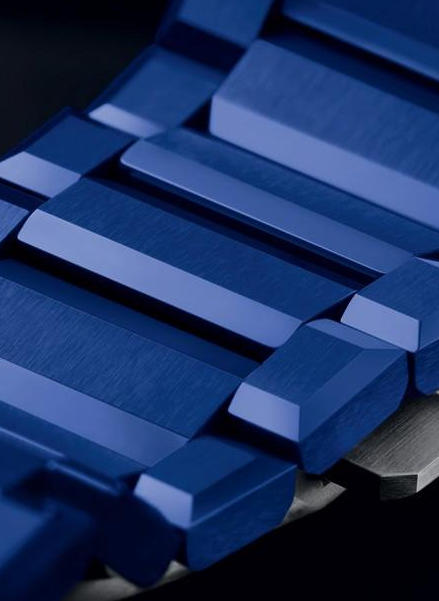
Blue Indigo is more restrained. It remains clearly different from black ceramic but does not compete as strongly with the openworked centre of the watch. That balance suits the Big Bang Integral because the dial already contains a considerable amount of information. The exposed movement, chronograph indications, date display, hands and hour markers all occupy the same visual space. A darker exterior allows those components to remain prominent.
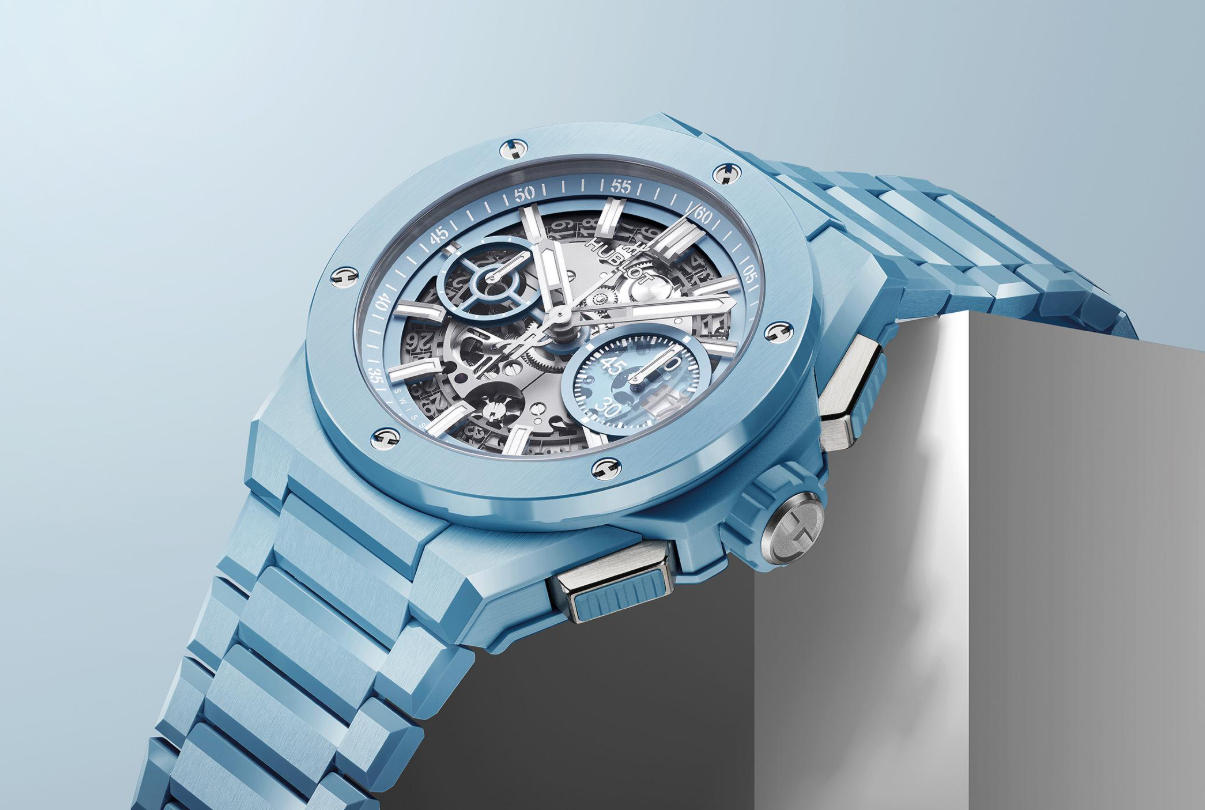
Sky Blue changes the character of the watch more dramatically. The lighter ceramic softens the aggressive lines of the Big Bang and places greater emphasis on the shape of the bracelet. It also illustrates one of the difficulties involved in judging coloured ceramic from photographs. Pale blue can look very different depending on lighting, camera processing and screen settings. A heavily lit studio image can make the ceramic appear far softer than it does under normal conditions. Anyone comparing an original watch with a replica version should therefore use several reliable images rather than treating a single photograph as a definitive colour reference.
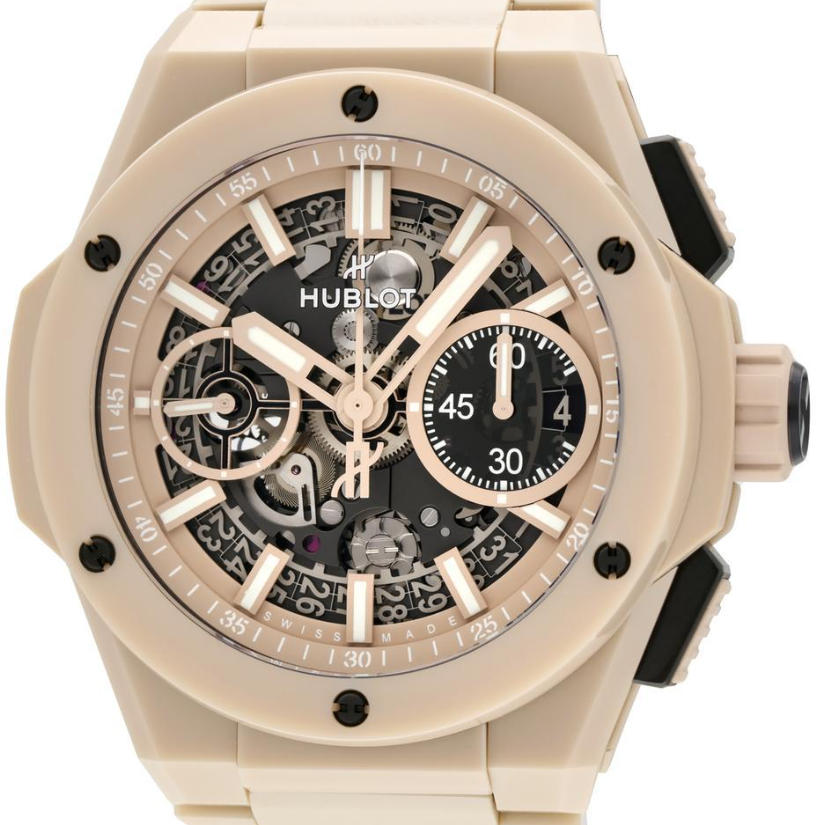
Sand Beige is quieter again, but it may be the most revealing of the four from a design perspective. Because the ceramic is relatively neutral, the darker movement components gain more contrast and the mechanical centre becomes easier to read. The case does not dominate the watch in the same way that Jungle Green does. Instead, the exposed movement becomes part of the overall colour composition. It is a good reminder that changing the ceramic affects more than the exterior. It changes how the entire watch is perceived.
The material tells more of the story than the colour
The real strength of these watches is the way ceramic is handled across such a complicated exterior. Hublot combines satin finished surfaces with polished details, allowing light to move differently across the bracelet, bezel and case. Without that contrast, an integrated ceramic watch could easily become visually flat. Instead, the finishing breaks up the large areas of colour and gives individual components more definition.
This is why the Hublot Big Bang Integral Ceramic bracelet construction deserves close attention. The bracelet is not simply a practical way to hold the watch on the wrist. It is one of the main design elements. Each link has to preserve the angular language of the Big Bang while still allowing the bracelet to articulate naturally. Small differences in link thickness, edge shape or surface finishing can noticeably change the character of the watch.
That becomes particularly relevant when comparing replica interpretations. Colour is usually the first thing people notice, but it is not necessarily the hardest part to reproduce convincingly. A green ceramic watch can look reasonably close in one photograph while still losing much of the original design through incorrect bracelet proportions, softer edges or inconsistent finishing. A convincing Hublot Big Bang Integral Ceramic replica therefore depends on far more than matching the general shade of the case.
Ceramic itself also behaves differently from coated metal. The colour belongs to the material rather than sitting on the surface as a thin external layer, which gives polished edges and brushed sections a different visual depth. On these watches, that characteristic is easy to see because ceramic covers almost the entire exterior. The more of the watch that uses one material, the more obvious differences in texture and finishing become.
The openworked centre adds another layer. All four editions use Hublot’s HUB1280 Unico automatic chronograph movement with approximately 72 hours of power reserve. The movement can be seen through the front of the watch and again through the sapphire caseback, so it functions as part of the design rather than hidden machinery.
This is where the four colours become particularly interesting when viewed together. The same movement looks more industrial inside Jungle Green, more subdued within Blue Indigo and more strongly defined against Sand Beige. Sky Blue makes the darker mechanics appear almost suspended inside the lighter ceramic frame. Mechanically, nothing important has changed between the four versions, yet the surrounding colour changes how the movement is read.
The HUB1280 Unico automatic chronograph movement is also one of the easiest areas to misunderstand when comparing genuine and replica watches. The original specifications belong to Hublot’s manufacture movement and should not automatically be transferred to another watch simply because the dial looks similar. A replica may use a completely different movement with different bridge shapes, chronograph architecture, power reserve and servicing requirements.
That difference is especially visible on an openworked design. On a watch with a conventional closed dial, much of the movement can remain hidden. The Big Bang Integral offers no such protection. Bridge positions, visible wheels, the date mechanism and the arrangement of the chronograph components all contribute to the appearance from the front. A movement that is mechanically functional can still look noticeably different if its architecture does not resemble the original.
This is also why broad quality labels are not especially useful when assessing this kind of watch. They do not tell you whether the bracelet meets the case correctly, whether the ceramic has the right texture or whether the openworked movement resembles the original layout. Our replica watch buying advice for UK readers takes the same approach: case proportions, movement claims, finishing and bracelet construction are better judged separately rather than reduced to one marketing term.
The original Integral Ceramic models were rated to 100 metres of water resistance, but that figure should also remain specific to the genuine watch. A visually similar replica should not be assumed to have the same sealing, construction or testing standards. Where water resistance matters, independent pressure testing is more meaningful than a printed specification.
Looking back from 2026, the four Integral Ceramic editions also make more sense within Hublot’s wider direction. The brand has continued to treat coloured ceramic as something more serious than an occasional novelty. Later Big Bang models have explored softer pastels, stronger blues and greens and other variations in ceramic tone. The earlier quartet now feels like part of that continuing development rather than a standalone colour exercise.
The Integral format was particularly well suited to that idea because it gave Hublot more ceramic surface to work with. A coloured bezel changes the face of a watch, but a coloured bracelet changes its whole silhouette. Here, the material moves continuously from the case around the wrist, allowing the colour to become part of the construction rather than something applied to one isolated component.
That is why the four versions remain interesting even though the underlying specifications are almost identical. Jungle Green gives the watch a stronger technical character. Blue Indigo is easier to imagine as an everyday option. Sky Blue makes the architecture feel lighter and more expressive, while Sand Beige allows the exposed mechanics to command more attention. The movement, dimensions and basic case remain the same, yet the watches do not feel interchangeable.
For anyone comparing the originals with replica interpretations, this is ultimately where the most useful observations lie. The colour may attract attention first, but the important details are more subtle: the shape of the bracelet links, the definition of the ceramic edges, the difference between polished and satin surfaces, the proportion of the case and the way the movement fills the openworked dial. Those details reveal far more than a colour name or a seller’s description.
The Big Bang Integral Ceramic quartet has aged well because its appeal was never limited to four unusual shades. These watches show Hublot using material, movement and bracelet construction as parts of the same design rather than treating them independently. In 2026, after several more years of coloured ceramic development from the brand, that approach feels even clearer. The colour may be what people remember first, but the integration of ceramic, mechanics and proportion is what gives these watches lasting interest.