Hublot’s Big Bang Meca-10 Street Art series makes the case surface as important as the movement. Presented around Art Basel Miami Beach, the four watches use cracked composite concrete cases that were hand painted by artist Saiff Vasarhelyi. Each version was produced in an edition of ten, so the project is small, but it extends a material idea Hublot has explored in Miami for years.
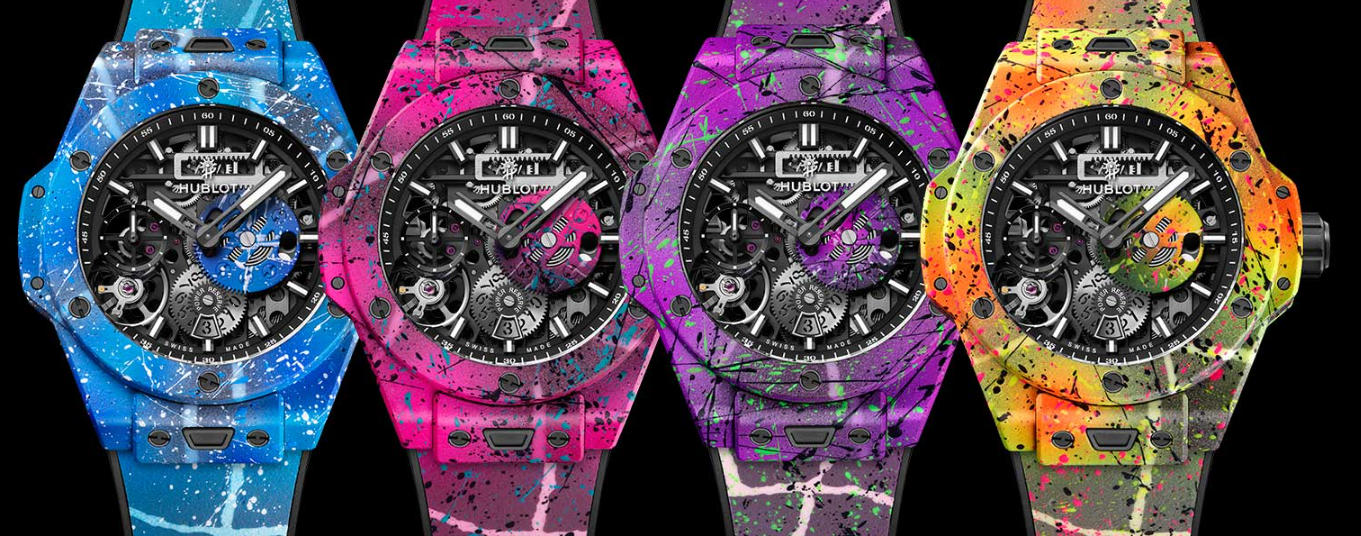
Four colour identities on one mechanical base
Magic City uses vivid pink lines across the grey case. Vice moves toward turquoise, Big Water mixes blue and violet, and Sunshine uses yellow. The painted lines continue into strap inserts and dial details, so colour is not restricted to a decorative ring around the watch. It moves through the entire composition.
That continuity is important when comparing replicas. A convincing version needs more than the right hue. The painted sections have to align with the geometry of the case and strap, while the concrete surface should remain visibly different from ceramic, resin or ordinary coated metal.

Miami is part of the design context
The original article traces Hublot’s Miami experiments back through earlier Art Basel projects, including work with Domingo Zapata, Mr. Brainwash and Tristan Eaton. Concrete had already appeared in that history, so the new cracked composite cases do not arrive without context. The city functions as a continuing environment for Hublot’s Art of Fusion idea, bringing watchmaking into contact with street art, performance and temporary installation.
The launch event included music and celebrity appearances, but those details are less important to the lasting value of the watches than the material experiment itself. Once the event is over, the question is whether the case still looks coherent next to the open Meca-10 architecture.
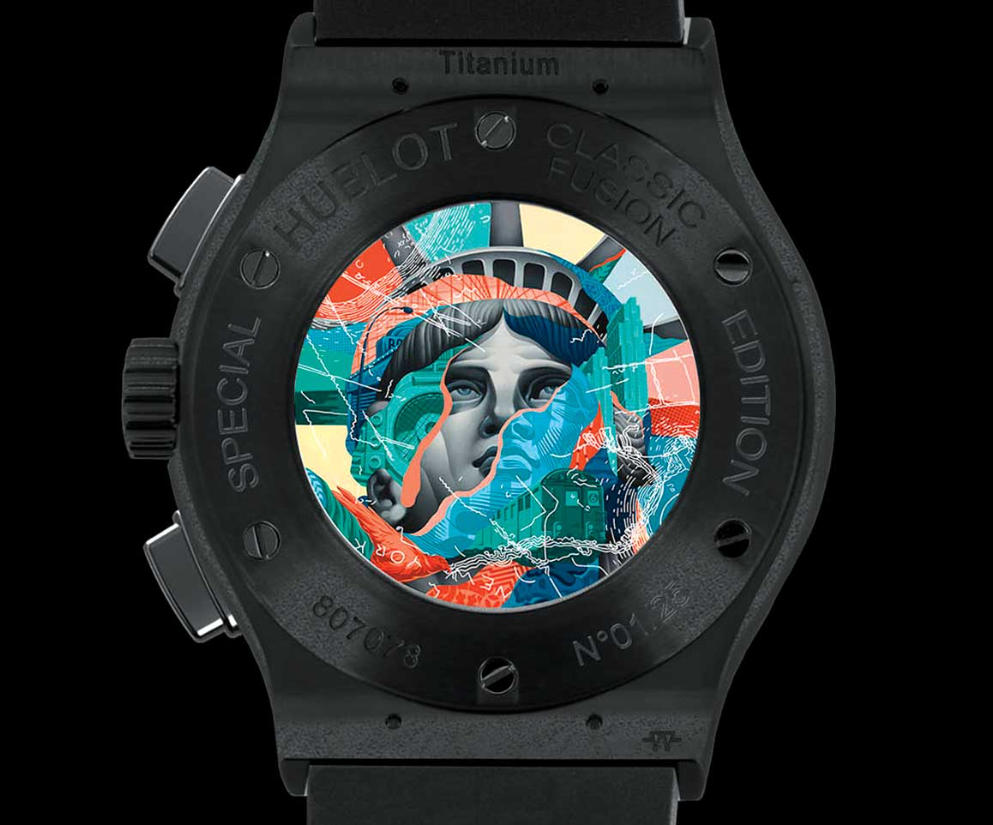
Visible mechanics make shortcuts obvious
The Meca-10 layout remains exposed, so a replica has two difficult jobs at once: reproduce an unusual case surface and create believable mechanical depth. The genuine watch’s movement architecture should be treated as a reference, not as proof of what is inside a replica. Decorative plates can imitate shapes in photographs while behaving very differently from the original mechanism.
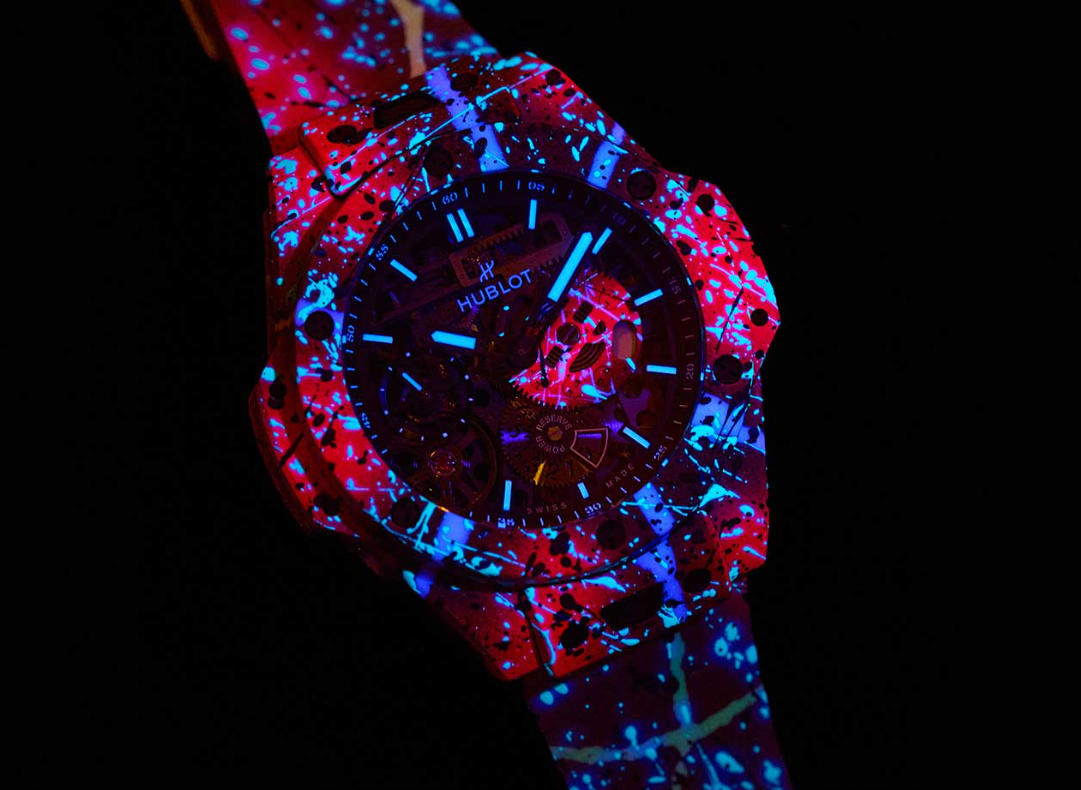
Where the collection fits
The Street Art series is not a new Hublot shape. Its originality comes from treating the familiar Big Bang case as a surface for another discipline. That makes it a useful extension of our Big Bang coverage, where case material and movement architecture can be compared across very different editions.
For Sports Watches UK, the editorial value of this model is precisely that it resists generic replica terminology. The details worth studying are concrete texture, hand-painted variation, colour continuity and mechanical depth. Those are specific, visible characteristics that can be compared without pretending that a seller label establishes construction quality.